No Surprise Bills: Predictable Pricing in the Age of Denial of Wallet
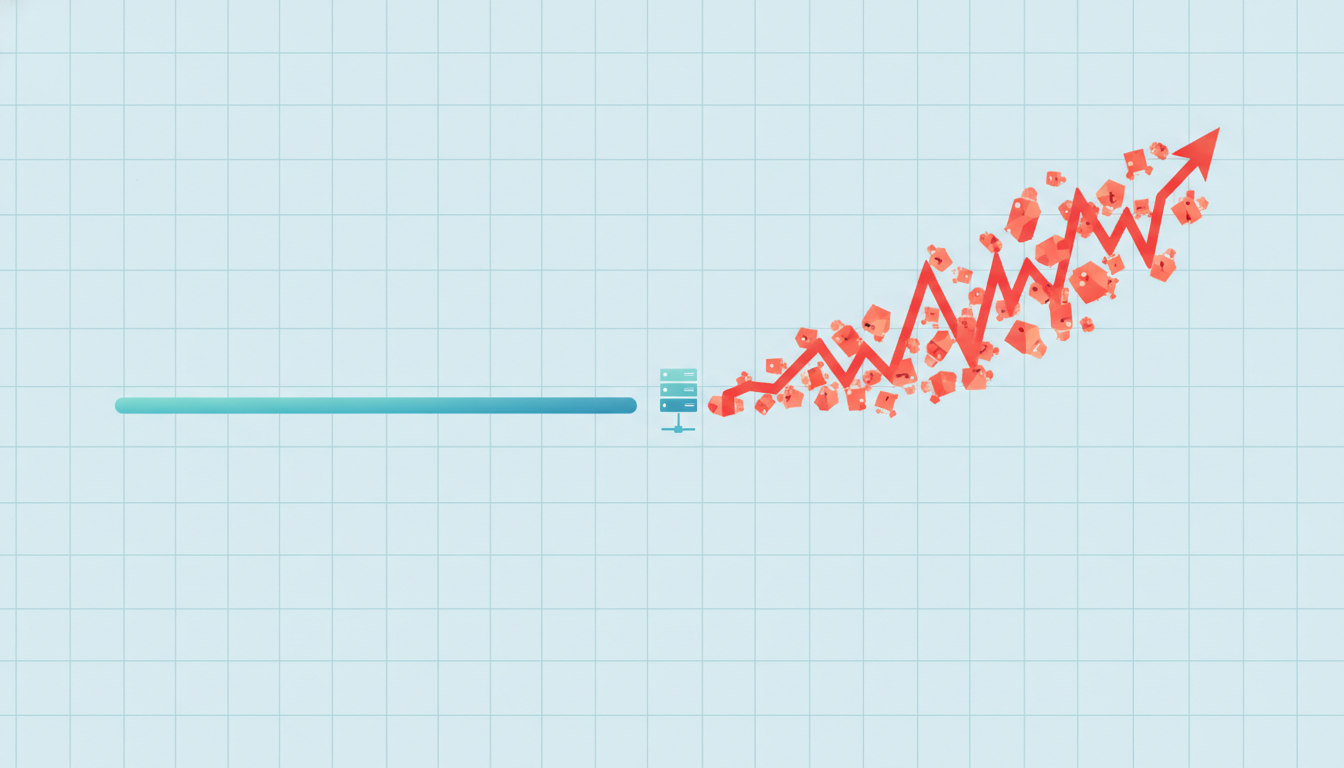
There's a specific kind of dread that only cloud developers know: opening your billing dashboard and finding a number with one more digit than you expected. Not double — an order of magnitude. The app didn't change. You didn't ship anything. Traffic just... happened. And because you're billed per request, per invocation, or per gigabyte of egress, the meter ran while you slept.
In May 2026, The Register ran a feature with a headline that landed a little too close to home: "Surprise AI bills leave AWS and Google Cloud users aghast." The pattern it describes is the same one a lot of indie hackers have been quietly living: automated traffic — AI agents, crawlers, scrapers, and outright bot swarms — hitting usage-metered services and dragging the bill up with it.
This post is about that gap between how you think you're billed and how you're actually billed, why AI-era traffic makes it worse, and where a flat per-hour instance price changes the math. Let's be honest up front about what that does and doesn't fix — because "predictable pricing" is a cost story, not a security guarantee.
Usage-metered billing is fine — until it isn't
Let's give usage-based pricing its due, because it's genuinely good a lot of the time.
When you have a brand-new project with five users, paying per request means you pay almost nothing. Scale-to-zero is a real feature. You're not renting a server that sits idle at 3am. For bursty, unpredictable, early-stage workloads, the model is elegant: your cost tracks your usage, and at low usage, that's a rounding error.
The problem isn't the model at steady state. The problem is that the same property that makes it cheap when usage is low — cost scales directly with traffic — makes it dangerous when traffic spikes for reasons that have nothing to do with your success.
A usage-metered bill has, in practice, no ceiling. It's a function of inbound traffic, and inbound traffic is not something you fully control. One viral post, one misconfigured retry loop, one aggressive crawler — and the number that was a rounding error becomes a number you have to explain to someone.
"Denial of wallet": when the attack is your invoice
Security people have a name for this now: a denial of wallet attack. Instead of trying to knock your service offline like a classic DDoS, the goal is to keep it online and hammer it — driving up your metered costs until the bill itself becomes the damage. Auto-scaling and per-request billing, the two features that make modern platforms feel magical, are exactly what the attack weaponizes: the more they hit you, the more you scale, the more you pay.
This isn't a fringe, theoretical concern anymore. The threat is mainstream enough that Vercel published its own guide on mitigating denial of wallet risks — when a major platform writes the defensive playbook for an attack on its own billing model, you know the problem is real.
A few honest data points on scale, with appropriate caveats:
- The traffic mix has flipped. A large share of all web traffic is now automated rather than human. AI crawlers like GPTBot, ClaudeBot, Bytespider, and PerplexityBot aggressively re-crawl dynamic routes and assets — and on a per-request or per-egress plan, you're paying to serve data that trains someone else's model.
- Developers have reported five-figure surprise bills from egress and request abuse. In one widely-discussed write-up, a Firebase project reportedly ran up tens of thousands of dollars in storage-egress charges before the developer noticed — and per that account the provider ultimately refunded it, but only after a public escalation, and not everyone gets that outcome. Other developers have described smaller-but-still-painful four-figure bills on unreleased projects, driven by AI bots finding them before launch.
A note on those figures, because honesty matters more than a scary stat: they come from developers' own write-ups and aggregator reporting, not audited primary records, and at least one case was refunded. That's exactly why we've kept them as ranges rather than precise dollar amounts — treat them as illustrative of a real pattern, not as guaranteed-final losses. The pattern itself — metered billing plus uncontrollable inbound traffic equals open-ended financial exposure — is well-documented (Vercel wrote a whole mitigation guide for it) and is the part that should change how you think about hosting.
Where a flat per-hour instance price changes the math
Here's the structural difference. With usage-metered billing, your cost is a function of traffic. With flat per-hour instance pricing, your cost is a function of the instance you chose to run — a number you picked, and a number you can forecast.
This is the model Deployra uses. You run your app as a container on Kubernetes on an instance with a known size and a known hourly rate. A traffic spike — legitimate or hostile — hits the instance you're already paying for. It doesn't silently multiply your bill per request, because there is no per-request meter to multiply.
The numbers are public and flat (from our pricing, monthly = hourly × 730):
- Web Service Basic-2GB (1.0 CPU, 2 GB RAM): $7.55/month
- Web Service Basic-512MB (0.5 CPU, 512 MB RAM): $3.17/month
- Web Service Basic-4GB (2.0 CPU, 4 GB RAM): $13.60/month
A typical full-stack app — one Web Basic-2GB plus a managed database (Basic-1GB at $4.35/month) — runs about $11.90/month. That's not "roughly twelve dollars plus whatever the internet decides to do to you this month." It's twelve dollars. If a bot swarm hammers your endpoint, the worst case at the billing layer is that your instance is busy — not that your invoice quietly grows a digit.
There's also a guardrail on the scaling side. Deployra's autoscaling uses Kubernetes HPA with explicit minReplicas and maxReplicas settings. You set the upper bound on how many replicas can spin up. So even under load, your scale — and therefore your cost ceiling — is capped at a number you defined, not at whatever the traffic demands. The meter doesn't get to decide how big you get.
Let's be precise about what this does and doesn't protect you from
If this post tells you flat pricing is a magic shield against abuse, it's lying to you. It isn't. Here's the honest boundary.
What a flat per-hour instance price genuinely gives you:
- A forecastable cost ceiling. Your monthly cost is the instances you run, full stop. You can put that number in a spreadsheet before the month starts and be right at the end of it.
- No per-request billing surface to attack. A denial-of-wallet attack works by inflating a meter. With flat instance pricing, hammering your endpoint doesn't inflate a per-request charge, because there isn't one. The financial blast radius of a traffic spike is bounded by the instance, not the request count.
- A scale cap you control. With HPA
maxReplicas, you decide the maximum footprint. Your cost can't scale past the bound you set.
What it does NOT do:
- It doesn't make you immune to attacks or abuse. A bot swarm can still degrade performance, exhaust a small instance, or affect availability. Flat pricing changes the financial exposure, not the security posture. You still want rate limiting, sane timeouts, and bot filtering at your application or proxy layer.
- It doesn't autoscale infinitely for free. This is the real tradeoff, and it's the honest one. A flat instance has finite capacity. If you get a genuine, sustained surge of legitimate traffic, you'll need a bigger instance or more replicas — and that costs more. The difference is that this is a predictable step you choose and can see coming, not a silent per-request multiplier that lands as a surprise. You trade "infinite invisible scaling" for "scaling you decide on and can budget for."
- It doesn't replace cost alarms and good hygiene. Wherever you host, set billing alerts, cap what you can, and watch your traffic. Predictable pricing makes the worst case smaller; it doesn't make monitoring optional.
That's the whole pitch, stated plainly: not "you can never get hurt," but "the worst case at the billing layer is a number you already know."
A quick gut-check for your own stack
You don't have to migrate anything to take the lesson. Spend ten minutes on these questions about wherever you deploy today:
- What's your worst-case bill this month? If you can't answer with a specific number, your cost is a function of traffic, not of a decision you made.
- What happens if a bot swarm finds your busiest endpoint? Does your invoice grow per request, or is it bounded by an instance you're already paying for?
- Do you have a scale ceiling? If your platform auto-scales, is there a
maxReplicas-style cap, or can it scale until your card declines? - Do you have billing alerts set? Predictable pricing helps, but alerts are still your seatbelt everywhere.
If those answers make you uncomfortable, you've found the same gap The Register's reporting and the denial-of-wallet conversation are pointing at — and it's worth closing on your terms.
The takeaway
Usage-metered billing isn't evil. It's a genuinely good fit for low, bursty, early-stage workloads. But it couples your bill to inbound traffic, and in 2026 inbound traffic increasingly means AI agents and bot swarms you didn't invite. That coupling is the surprise-bill mechanism — and "denial of wallet" is just its name when someone does it to you on purpose.
A flat per-hour instance price breaks that coupling at the billing layer. Your cost becomes the instances you chose to run — a Web Basic-2GB is $7.55/month, a full-stack app around $11.90/month — and your scale is capped at a maxReplicas bound you set. It won't make you invincible. It will make your worst case a number you can forecast.
That's the entire promise of no surprise bills: not that nothing can go wrong, but that the bill isn't the thing that goes wrong.
Related Articles
- What the Railway Outage Teaches You About Who Owns Your Deployment
- Vercel Alternative: Predictable Pricing for Developers
- Cut Your Startup Cloud Costs
Forecast Your Bill, Not Your Anxiety
Stop wondering what the internet will do to your invoice this month. Try Deployra — full-stack deployment on Kubernetes with flat per-hour instance pricing from $3.17/month, a scale ceiling you control, and no per-request meter for a bot swarm to run up.